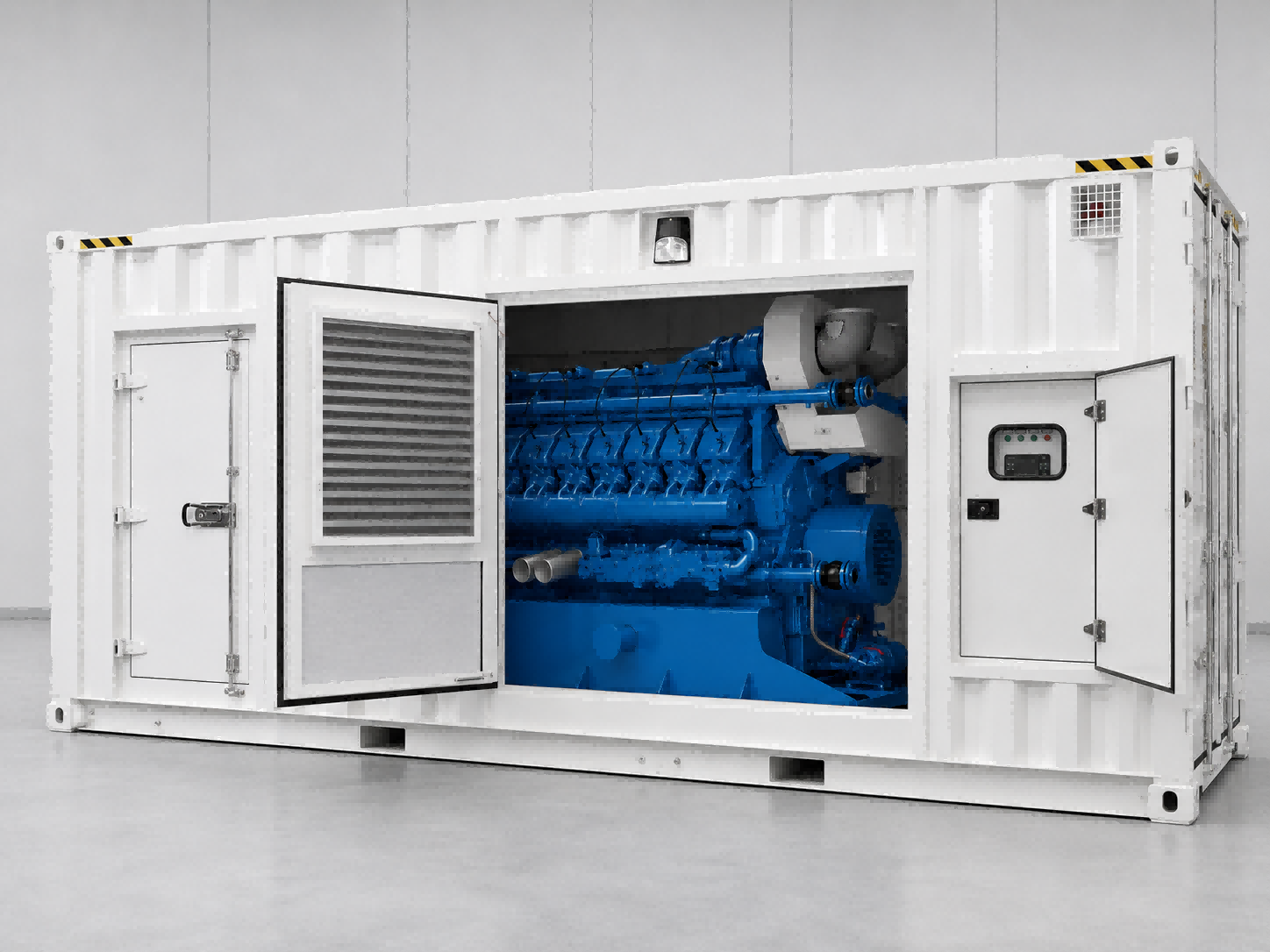
AI data centers require robust backup power solutions to ensure continuous operation. Leading options include diesel generators such as SWT Diesel Generator Sets, natural gas generators, battery energy storage systems, hydrogen fuel cells, modular and scalable systems, and UPS systems. Reliability, scalability, and sustainability drive the selection process. Redundant configurations and seamless integration keep systems online during unexpected events.
- AI data centers need reliable backup power solutions to maintain continuous operation during outages.
- Diesel generators are a popular choice due to their efficiency and rapid response, making them ideal for critical workloads.
- Battery energy storage systems enhance sustainability and reduce operational costs by allowing energy use during peak pricing.
- Implementing redundancy strategies, like N+1 or 2N configurations, ensures high fault tolerance and operational flexibility.
- Integrating renewable energy sources, such as solar and hydrogen, supports sustainability goals while providing reliable power.
Backup Power Needs
AI Workload Demands
AI data centers operate at much higher power levels than traditional facilities. The rise of GPU and TPU racks has transformed the energy landscape. The following table illustrates the difference in power requirements:
| Workload Type | Power Requirement per Rack |
|---|---|
| AI Workloads | 30-80 kW |
| Traditional Workloads | 8-15 kW |
| Power Consumption per AI Chip | 700W – 1200W |
| GPUs per Server | Typically 8 |
| Equivalent Traditional Racks | 20-30 |
AI workloads generate rapid fluctuations in power demand. Processing tasks can cause power draw to surge or dip, requiring robust power management. UPS systems play a critical role by providing immediate power during outages. They are engineered to handle high demands from dense GPU racks. Selection criteria for UPS include power ratings, cycle life, energy density, and thermal management. Diesel generators deliver large power quickly and are cost-effective for backup power. Integration of renewable sources, such as solar PV and hydrogen fuel cells, supports sustainability goals. Automatic transfer switches ensure rapid response during outages.
Power Outage Risks
Power failures account for nearly half of impactful outages in data centers. Electrical problems cause 52% of these incidents. The most common issues include UPS failures, transfer switch failures, and generator failures. These risks highlight the need for reliable backup power systems and redundancy strategies.
“We are being asked to be bigger, cleaner, faster, smarter, and more resilient all at once,” said Amber Villegas-Williamson, principal consultant for Uptime Institute.
AI data centers must address these risks with scalable and resilient backup power solutions. Proper planning and integration help maintain uptime and protect critical workloads.
Backup Power Sources
Diesel Generators
Diesel generators remain a cornerstone for backup power in AI data centers. Their efficiency, reliability, and rapid response make them ideal for critical workloads. SWT Diesel Generator Sets exemplify this technology, offering a comprehensive range tailored to diverse operational needs. The SME Series delivers up to 1800kW (2250kVA), suitable for both prime and standby applications. The Baudouin Series provides robust output at 2000kW (2500kVA), ensuring dependable energy during demanding scenarios. For compact requirements, the Yuchai Series features turbocharged engines with stable performance, while the Shangchai Series offers balanced output at 300kW (375kVA) for medium-scale operations. The Perkins Series is versatile, with a prime power output of 160kW (200kVA). Kubota Series models, such as the 24kW (30kVA) unit, fit industrial spaces where footprint matters. Cummins Series generators deliver up to 2000kW (2500kVA), covering high-capacity needs.
The following table compares diesel generators with natural gas generators:
| Aspect | Diesel Generators | Natural Gas Generators |
|---|---|---|
| Efficiency | Diesel is more efficient, with 137,381 BTU per gallon compared to 1,036 BTU per cubic foot for natural gas. | Less efficient than diesel. |
| Emissions | Higher carbon footprint, contributing to 10% of U.S. energy-related CO2 emissions. | Cleaner-burning fuel, emits fewer greenhouse gases than diesel. |
| Operational Costs | More cost-effective due to wide availability, simple storage, and stable pricing. | Requires additional infrastructure, making it less cost-effective. |
SWT Diesel Generator Sets incorporate advanced technology to maximize uptime and minimize environmental impact. Their modular design allows for easy integration and scalability, supporting the evolving demands of AI workloads.
Natural Gas Generators
Natural gas generators offer a cleaner alternative to diesel, emitting fewer greenhouse gases and aligning with sustainability goals. They are increasingly adopted in regions with robust gas infrastructure. While less efficient than diesel, natural gas generators provide reliable backup power and reduce the carbon footprint of data centers. Operators must consider the need for additional infrastructure, which can affect operational costs and deployment timelines.
Bloom Energy Servers represent a modern approach to backup power. These systems generate electricity on-site using natural gas, achieving availability rates between 99.9% and 99.999%. Unlike traditional generators, Bloom Energy Servers are less susceptible to grid outages and extreme weather. Their fuel cells produce significantly lower carbon emissions and harmful pollutants, supporting corporate sustainability objectives. Deployment can occur in as little as 90 days, offering a faster and more scalable solution compared to conventional grid connections.
Battery Storage
Battery energy storage systems are transforming backup power strategies in AI data centers. They enable time-of-use energy arbitrage, allowing operators to charge batteries when electricity is inexpensive and discharge during peak pricing. This reduces operational costs and supports renewable energy integration. Batteries also handle rare demand peaks, minimizing the need for oversized infrastructure and reducing cooling requirements. Infrastructure upgrades can be deferred, as batteries manage occasional surges without expanding substations.
- Batteries eliminate diesel emissions and enable renewable energy usage.
- They enhance reliability by providing seamless transitions during outages.
- Scalability supports growing data center demands.
- Cost benefits include reduced demand charges and improved operational efficiency.
Battery systems align with sustainability goals and improve uptime. However, operators must evaluate initial costs, backup duration, and environmental considerations related to battery production and disposal.
Hydrogen Fuel Cells
Hydrogen fuel cells are gaining traction as a backup power solution for AI data centers. Developers are pivoting to fuel cells due to their rapid deployment and materially lower emissions. Oracle and BorderPlex have announced projects replacing gas turbines and diesel generators with up to 2.45 GW of fuel cells from Bloom Energy, signaling large-scale adoption.
“Fuel cell systems provide an emerging backup power option that combines the environmental benefits of renewable energy with the reliability of on-site generation.”
Fuel cells offer faster deployment compared to combustion-based alternatives. Their environmental benefits make them attractive for organizations pursuing carbon-neutral operations.
Modular Systems
Modular and scalable backup power systems enhance reliability and flexibility in AI data centers. Modular design adapts to various site requirements, supporting both small and large facilities. Automotive-grade battery technology ensures high reliability. These systems optimize energy costs through peak shaving and load management, reducing total cost of ownership.
| Year | Percentage of Data Centers Using Onsite Generation | Fully Powered by Onsite Generation |
|---|---|---|
| 2022 | 13% | N/A |
| 2030 | 38% | 27% |
- Modular systems allow for adaptation to changing workloads.
- They balance performance and cost, supporting long-term growth.
- High reliability ensures continuous operation during power disruptions.
“Small modular reactors (SMRs) are the future of nuclear power. Big tech companies have already taken notice. Amazon, Google, and Microsoft are investing in SMR ventures to meet the soaring power demands of their AI data centers.”
Aggreko provides temporary and scalable backup power solutions. Their emergency power services ensure rapid deployment and reliable performance during equipment failures or demand spikes. Aggreko’s solutions do not impose a capital expenditure burden, making them cost-effective for short-term needs. The company has expanded its liquid-cooled load bank fleet by 120MW to meet the rising demand for commissioning equipment in high-density data centers.
UPS Systems
UPS systems play a critical role in providing instantaneous backup power during transitions. Graphene supercapacitors enable immediate energy storage, responding to load demands without delay. This capability is essential for AI data centers, where seamless transitions from grid power to backup power prevent service interruptions.
UPS systems serve as a bridge during power disturbances. When utility power fails, UPS units instantly supply power from their batteries, ensuring uninterrupted operation. Their primary mission is to maintain critical loads while the power system stabilizes. UPS systems protect valuable computing resources and guarantee operational continuity.
AI data centers rely on UPS systems to deliver reliable, instantaneous backup power. These systems are scalable and integrate seamlessly with other backup power solutions, supporting maximum uptime and resilience.
Redundancy Strategies
N+1 and 2N
Redundancy strategies form the backbone of reliable power infrastructure in AI data centers. N+1 redundancy is the most common approach. It provides one backup for every group of N components, such as generators or UPS units. This model ensures that if a single component fails, the backup can take over. However, N+1 may not protect against multiple simultaneous failures.
2N redundancy offers a higher level of fault tolerance. This strategy duplicates the entire power system, creating two independent sets of components. Operators can perform maintenance on one set without disrupting operations. The data center continues to function even if one set fails.
A 2N redundancy model creates a mirror image of the original UPS, cooling system or generator arrangement to provide full fault tolerance. This design allows the data center operator to take down an entire set of components for maintenance without interrupting normal operations.
| Redundancy Type | Description | Fault Tolerance Level |
|---|---|---|
| N+1 | One backup component for every N component. | Limited; can fail if multiple components fail simultaneously. |
| N+2 | Two backup components for every N component. | Higher; can handle two simultaneous failures. |
| 2N | Two complete sets of components. | Fully fault-tolerant; can operate normally even if one set fails. |
2N redundancy delivers full fault tolerance and operational flexibility. It requires more investment and space but maximizes uptime for mission-critical workloads.
Hybrid Systems
Hybrid systems combine multiple technologies to enhance reliability and sustainability. Battery energy storage systems deliver instantaneous power and improve power quality. These systems integrate with renewable energy sources, reducing carbon intensity. Hydrogen fuel cells add another layer of efficiency, producing only heat and water as byproducts.
- Hybrid renewable systems maximize availability by combining clean energy sources.
- Wind and solar generation complement each other, balancing power supply throughout the day.
- Green hydrogen enables long-term energy storage, supporting backup power during extended outages.
Hybrid systems allow operators to optimize energy use and reduce environmental impact while maintaining continuous operations.
Automated Switching
Automated switching technologies ensure seamless transitions between primary and backup power sources. Advanced switchgear solutions minimize downtime by instantly transferring loads. The integration of AI and analytics in power management has become a key trend. These systems support uninterrupted operations, which are essential for AI data centers.
- Modular and scalable electrical systems address the needs of hyperscale and colocation facilities.
- Energy-efficient infrastructure supports sustainable growth.
Automated switching enhances reliability and supports the complex demands of modern data centers.
Sustainability & Future-Proofing
Renewable Integration
Data centers are increasingly adopting renewable energy sources to support sustainability goals. Operators deploy hybrid renewable systems that combine wind, solar, and green hydrogen. These systems deliver reliable power and reduce carbon emissions. Green hydrogen enables long-term energy storage, ensuring continuous operation during extended outages. Lithium-ion batteries provide fast response and high power density, which is essential for AI workloads. Fuel cell systems use hydrogen to generate electricity, producing only water vapor as a byproduct. These technologies integrate seamlessly with existing infrastructure, supporting a transition to carbon-free operations.
Tip: Renewable integration not only lowers emissions but also improves resilience against grid disruptions.
Emerging Tech
The industry is cautious about adopting new technologies due to reliability concerns. Pilot projects allow operators to test innovations before full-scale deployment. Several promising technologies are emerging:
- Solid-state lithium-metal batteries offer higher energy density and improved safety margins. They reduce thermal-runaway risk, making them suitable for dense AI facilities.
- Large-scale battery systems provide emissions-free power and quick response times. These systems can also deliver grid services during normal operations.
- Generator systems with dual-fuel configurations offer flexibility and extended backup power.
- Fuel cell systems integrate renewable energy for continuous, carbon-free power generation.
Operators evaluate these technologies for scalability, safety, and performance. Gradual adoption ensures reliability and supports future-proofing strategies.
Planning Ahead
Strategic planning is vital for scalable and sustainable power infrastructure. Data center operators collaborate with power companies and grid operators to streamline regulatory processes. Partnerships accelerate infrastructure development and facilitate access to clean energy resources. Redeveloping closed plant sites into data center campuses leverages existing capacity and expedites deployment. Utilizing surplus interconnections reduces wait times for new generation connections. A recent clean transition tariff approval demonstrates regulatory support for sustainable energy solutions. Most operators view collaboration with utilities as the top strategy to meet growing energy demands.
Note: Proactive planning and collaboration help data centers stay ahead of rising workloads and evolving sustainability requirements.
Best Practices
Power Assessment
Effective power assessment forms the foundation of reliable AI data center operations. Operators should prioritize strategic site selection, focusing on power availability and evaluating utility capacity. Infrastructure must be sized using a power-first design methodology, ensuring support for maximum AI workload requirements. Integrated cooling solutions help manage heat generation from dense compute racks. Advanced monitoring systems, including sensors, track power consumption and optimize energy usage. Modular components provide flexibility, allowing infrastructure to adapt as workloads grow. Sustainability integration, such as renewable energy and efficiency measures, should be considered from the outset. Redundancy optimization balances reliability with cost, often through N+1 configurations. Commissioning and testing protocols validate systems under full load before production.
- Strategic site selection
- Power-first design methodology
- Integrated cooling solutions
- Advanced monitoring implementation
- Flexible infrastructure deployment
- Sustainability integration
- Redundancy optimization
- Commissioning and testing protocols
Vendor Selection
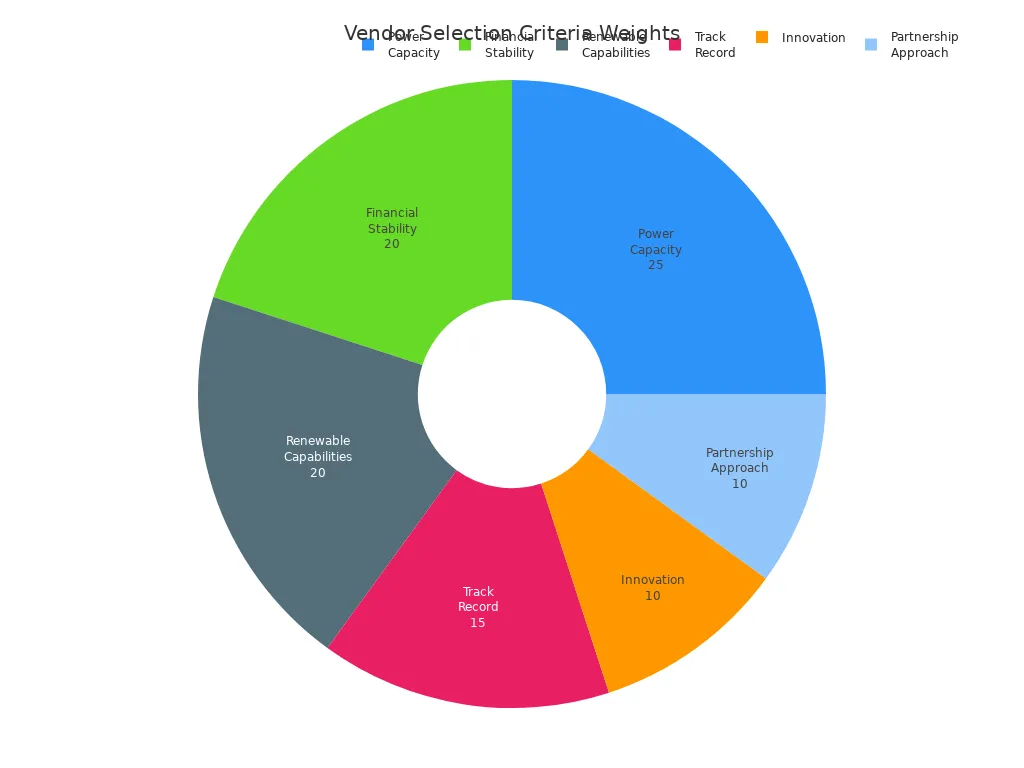
Selecting the right vendor requires a structured evaluation process. Operators must review technical specifications to ensure sufficient power capacity. Financial stability is assessed through credit analysis and references. Renewable capabilities are evaluated by examining the vendor’s portfolio. Track record is verified with project case studies. Innovation is measured by reviewing the technology roadmap. The partnership approach is assessed for cultural fit.
| Evaluation Criteria | Weight | Assessment Method |
|---|---|---|
| Power Capacity | 25% | Technical specifications review |
| Financial Stability | 20% | Credit analysis & references |
| Renewable Capabilities | 20% | Portfolio assessment |
| Track Record | 15% | Project case studies |
| Innovation | 10% | Technology roadmap review |
| Partnership Approach | 10% | Cultural fit assessment |
Tip: A vendor with a strong track record and innovative solutions can help future-proof your data center.
Deployment & Maintenance
Deployment and maintenance procedures must align with operational requirements. UPS systems provide instantaneous backup and support AI rack loads exceeding 80kW. Generator systems deliver extended backup power, with natural gas advantages and redundancy through N+1 or 2N configurations. Energy storage systems offer emission-free operation and fast response times, supporting grid services. Redundant utility connections eliminate single points of failure by linking multiple substations. Fuel cell systems integrate renewable energy and enable continuous operation with hydrogen fuel.
| Backup Power System Type | Key Features | Configuration Recommendations |
|---|---|---|
| Uninterruptible Power Supply (UPS) | Instantaneous backup, lithium-ion batteries | Supports AI rack loads exceeding 80kW |
| Generator Systems | Extended backup power, natural gas advantages | N+1 or 2N configurations for redundancy |
| Energy Storage Systems | Emission-free, operational advantages | Fast response times, grid services |
| Redundant Utility Connections | Eliminates single points of failure | Multiple utility substations |
| Fuel Cell Systems | Renewable energy integration, clean byproduct | Continuous operation with hydrogen fuel |
Regular maintenance schedules and system testing are essential for ensuring reliability.
Compliance & Safety
Compliance and safety standards protect both personnel and infrastructure. Operators must adhere to local and international regulations, including electrical codes and environmental requirements. Safety protocols should cover emergency procedures, fire suppression systems, and hazardous material handling. Training programs ensure staff understand operational risks and response strategies. Documentation and audits help maintain compliance and identify areas for improvement.
Note: Proactive compliance management reduces risk and supports uninterrupted operations.
AI data centers require robust solutions for continuous operation. The following table compares key backup power options:
| Option | Reliability | Scalability | Sustainability |
|---|---|---|---|
| UPS Systems | Temporary power | Limited capacity | Not sustainable long-term |
| Generators | Operational during outages | Expensive to scale | Depends on fuel supply |
| On-Site Generation | Most reliable | High cost, experimental | Source-dependent |
Operators should integrate hybrid systems, plan for fuel storage, and use advanced monitoring. Regular load testing, redundancy, and scalable infrastructure support future growth. Consider compact UPS for limited space and online double conversion for mission-critical needs.
Planning ahead and following best practices ensures reliability, scalability, and sustainability for AI data centers.
FAQ
What is the most reliable backup power source for AI data centers?
Diesel generators, such as SWT Diesel Generator Sets, provide unmatched reliability for critical workloads. Their rapid response and robust design ensure continuous operation during outages. Many operators choose them as the primary backup solution for mission-critical environments.
How do UPS systems support AI data centers during power loss?
UPS systems deliver instantaneous power when the main supply fails. They bridge the gap until generators or other backup sources activate. This prevents downtime and protects sensitive AI workloads from abrupt shutdowns.
Can battery storage fully replace traditional generators?
Battery storage offers fast response and supports sustainability goals. However, for extended outages, traditional generators remain essential. Many data centers use batteries and generators together for optimal reliability and flexibility.
Are hydrogen fuel cells a practical option today?
Hydrogen fuel cells are emerging as a viable backup power source. They provide clean energy and fast deployment. Adoption is growing, but most facilities still rely on established solutions like diesel or natural gas generators for primary backup.
What factors should guide backup power vendor selection?
Key factors include power capacity, financial stability, renewable capabilities, track record, innovation, and partnership approach. Operators should evaluate vendors using a structured process to ensure alignment with operational and sustainability goals.