
To compare diesel, gas, and hybrid power for mining, evaluate five criteria: total cost of ownership, fuel efficiency, emissions, infrastructure, and operational fit. No single power source wins everywhere. Project duration, location, regulations, and fleet duty cycles shape the right choice. Diesel generators, like those from SWT, remain a trusted baseline. Gas offers cost advantages where pipelines exist. Hybrid systems deliver fuel savings of 10–30% in suitable cycles. This guide provides a step-by-step decision framework. It helps you weigh trade-offs and select the most practical power solution for your mine site.
Criteria to compare diesel, gas, and hybrid
Selecting the right power source for a mining operation requires a structured evaluation. Three core criteria drive the decision: total cost of ownership, fuel efficiency and energy density, and emissions and regulatory fit. Each criterion carries different weight depending on the project. A remote site with no pipeline access faces different constraints than a mine near a gas distribution network. Understanding these criteria helps operators compare diesel, gas, and hybrid options with clarity.
Total cost of ownership
Total cost of ownership extends far beyond the initial purchase price. It includes capital expenditure, ongoing fuel costs, maintenance, and downtime. Mining operators must evaluate both upfront and lifecycle expenses to make an informed choice.
CapEx vs. lifecycle costs
Diesel machines often cost less to buy than gas or hybrid alternatives. This lower upfront investment makes diesel attractive for projects with tight initial budgets. However, lifecycle costs tell a different story. Electricity is cheaper per unit than diesel fuel, which benefits hybrid systems that rely on grid charging or regenerative power. Short-term projects favor diesel because the lower capital outlay pays off quickly. Long-term projects see more value in hybrids, where fuel savings accumulate over years of operation. A mine running for five years may find diesel more economical. A mine operating for fifteen years may find hybrid systems deliver superior returns.
Maintenance, fuel, and downtime
Maintenance requirements vary significantly across power sources. Diesel engines have well-established service networks and predictable maintenance schedules. Gas engines burn cleaner and may experience less wear on certain components, but they require specialized technicians. Hybrid systems introduce battery maintenance and power electronics servicing. Fuel costs represent a major ongoing expense. Diesel prices fluctuate with global markets. Gas prices remain more stable in regions with domestic production. Downtime affects productivity. Diesel generators have proven reliability with readily available parts. Hybrid systems may require longer waits for specialized components. Operators must weigh these factors against their tolerance for risk and their access to service support.
Fuel efficiency and energy density
Energy density determines how much power a fuel source delivers per unit of weight or volume. Fuel efficiency measures how well the system converts that energy into useful work. These factors directly impact operational costs and logistics.
Diesel’s high energy density
Diesel fuel offers high energy density compared to alternatives. This means a smaller volume of fuel delivers more power. Mining equipment can operate longer between refueling stops. Haul trucks and excavators benefit from this characteristic. Diesel’s energy density also simplifies storage. Tanks require less space. Transport to remote sites becomes more manageable. Modern diesel engines continue to improve. Some achieve fuel savings through advanced combustion and aftertreatment systems.
Gas’s lower density, cleaner combustion
Natural gas has lower energy density than diesel. Engines require more fuel volume to produce equivalent power. This affects storage and transport logistics. Gas engines burn cleaner, which reduces certain emissions and may extend engine life. The cleaner combustion also lowers maintenance costs for components like filters and lubricants. Mines near pipelines can access gas directly. Sites without pipeline access must arrange LNG or CNG delivery, which adds complexity and cost.
Hybrid’s regenerative savings
Hybrid systems capture energy that would otherwise be lost. Regenerative braking recovers kinetic energy during descent or deceleration. This energy charges onboard batteries. The stored power then assists acceleration or powers auxiliary systems. Hybrid configurations deliver fuel savings of 10–30% in suitable duty cycles. Haul trucks on descending ramps see the greatest benefit. Stop-start cycles in underground operations also favor hybrid power. The savings compound over time, offsetting higher initial costs.
Emissions and regulatory fit
Emissions regulations continue to tighten across the mining industry. Operators must select power sources that meet current standards and anticipate future requirements. Compliance protects air quality and avoids penalties.
Diesel particulates and NOx
Diesel engines produce particulate matter and nitrogen oxides. These emissions face strict limits in many jurisdictions. Modern aftertreatment systems reduce these pollutants significantly. Diesel particulate filters and selective catalytic reduction systems help engines meet Tier 4 Final and Stage V standards. These systems add cost and complexity. They also require regular maintenance and reagent refills. Mines in regulated regions must account for these expenses.
Gas reduced CO2 and methane slip
Natural gas combustion produces less carbon dioxide than diesel. This advantage supports emissions reduction goals. Gas engines also produce fewer particulates and nitrogen oxides. However, methane slip remains a concern. Unburned methane escapes during combustion and has a higher global warming potential than CO2. Engine manufacturers continue to address this issue through improved combustion control. Mines operating under strict emissions caps often find gas an attractive option.
Hybrid idle reduction benefits
Hybrid systems reduce emissions by cutting idle time. Mining equipment often idles during loading, waiting, or operator breaks. Hybrid power allows engines to shut down during these periods. Battery power maintains auxiliary systems. This idle reduction lowers fuel consumption and emissions. Underground mines benefit from reduced ventilation requirements. Less exhaust means lower ventilation load and energy costs. Hybrid systems also operate more quietly, which improves working conditions.
Diesel power for mining
Diesel generators remain the industry standard for mining power. They have proven their reliability over decades of operation. SWT manufactures diesel generator sets ranging from 8.3 kVA to 3781 kVA, covering standby, prime, and continuous power applications. When operators compare diesel against gas and hybrid options, diesel consistently demonstrates strengths in infrastructure maturity and load handling.
Diesel advantages
Diesel power offers two major benefits for mining operations: established support systems and superior torque delivery.
Established infrastructure and reliability
Diesel fuel distribution networks span the globe. Remote mine sites can receive fuel deliveries by truck without building new pipelines or charging stations. Service technicians familiar with diesel engines are widely available. Parts supply chains are mature and competitive.
| Metric | Detail |
|---|---|
| Operating power share in mining | ~70% of a mining operation’s operating power |
| Industrial segment market share (includes mining) | 57.5% share in 2025 |
| Mining operation scale and lifespan | 10–20 MW captive generation; equipment lifespans 20+ years |
These figures confirm diesel’s dominant position. A single mining operation often deploys 10–20 MW of captive generation. Equipment lifespans exceed 20 years. Diesel generators support this scale with predictable performance.
High torque for heavy loads
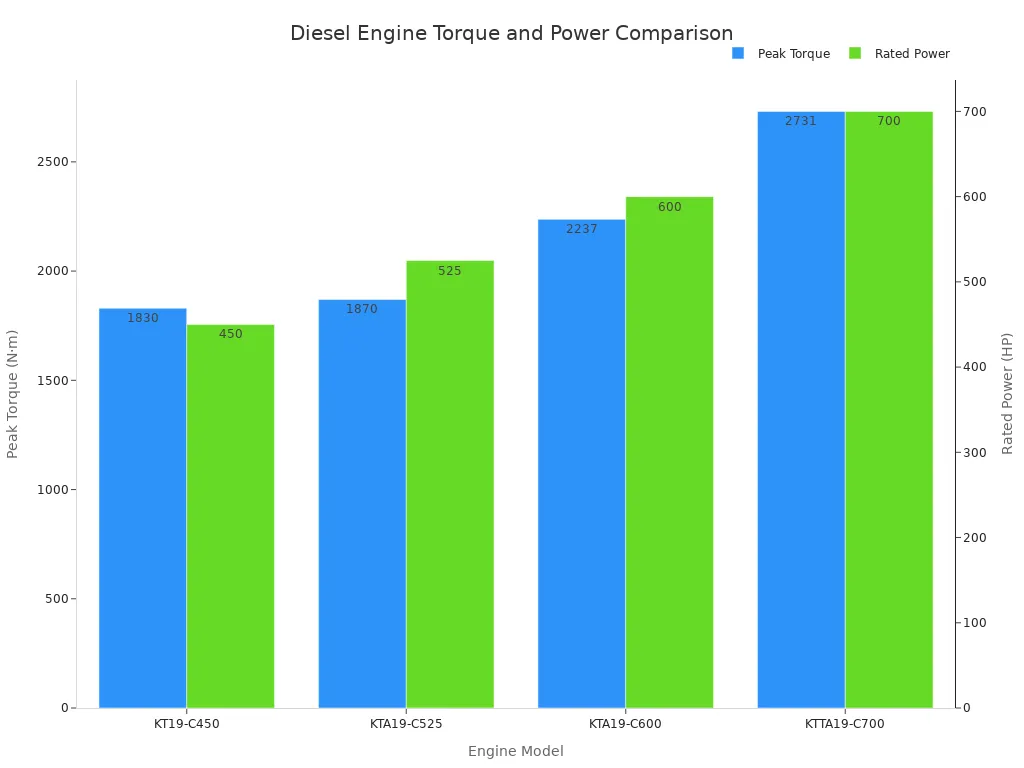
Diesel engines deliver high torque at low RPM. This characteristic enables smooth operation under heavy mining loads without strain.
High torque at low RPM enables diesel engines to operate smoothly under heavy mining loads without strain, providing resistance to sudden load changes and stable movement. This reduces mechanical stress and ensures consistent power delivery.
| Engine Model | Peak Torque (N·m @ rpm) | Rated Power (HP) | Application / Load Response |
|---|---|---|---|
| KT19-C450 | 1,830 @ 1,500 rpm | 450 | General heavy load |
| KTA19-C525 | 1,870 @ 1,500 rpm | 525 | Bulldozing, push-load; stable torque under push-load operation |
| KTA19-C600 | 2,237 @ 1,500 rpm | 600 | Heavy mining equipment |
| KTTA19-C700 | 2,731 @ 1,300 rpm | 700 | High altitude, extreme loads |
Diesel disadvantages
Diesel power faces two significant challenges: tightening emissions rules and unpredictable fuel expenses.
Stricter emissions regulations
Governments worldwide continue to tighten diesel emissions standards. Particulate matter and nitrogen oxides face strict limits. Modern aftertreatment systems meet Tier 4 Final and Stage V requirements. These systems add cost and maintenance complexity.
Fuel price volatility and aftertreatment costs
Diesel prices fluctuate with global markets. Aftertreatment components require regular service and reagent refills. These ongoing expenses raise the total cost of ownership over time.
Best use cases
Diesel power excels in specific mining scenarios.
Remote sites with no gas pipeline
Mines far from gas infrastructure rely on diesel. Fuel trucks reach these locations without pipeline construction.
Short-term or high-utilization operations
Projects lasting under five years favor diesel’s lower upfront cost. High-utilization operations benefit from diesel’s proven durability.
Gas power for mining
Natural gas power presents a compelling alternative for mining operations seeking lower fuel costs and reduced emissions. SWT offers gas generator sets as part of their green energy solutions, supporting low-emission mining operations. Gas power requires new fuel storage and transport infrastructure, but it delivers meaningful advantages in suitable locations.
Gas advantages
Lower fuel cost and CO2 emissions
Natural gas benefits from domestic abundance in many regions. This supply advantage translates into lower and more stable fuel prices compared to diesel. Mines operating near gas-producing regions access fuel at a fraction of diesel’s cost. Gas combustion produces less carbon dioxide per unit of energy delivered. This reduction helps mines meet emissions targets without complex aftertreatment systems.
Cleaner combustion, less engine wear
Gas burns with fewer impurities than diesel. This cleaner combustion reduces carbon deposits inside the engine. Oil change intervals extend by a significant margin. Components like spark plugs and filters experience less stress. Maintenance costs per operating hour often decrease compared to diesel counterparts. The reduced particulate loading eases demands on ventilation systems in underground operations.
Gas disadvantages
Higher capital for engines and fuel systems
Gas engines require specialized fuel delivery systems. Compressors, vaporizers, and storage tanks add to the initial investment. Sites without pipeline access must arrange LNG or CNG transport. This infrastructure represents a significant capital outlay that diesel operations avoid. The higher upfront cost demands a longer operating horizon to achieve payback.
Methane leakage and lower energy density
Natural gas delivers less energy per unit volume than diesel. Engines must process more fuel to produce equivalent power. Storage requirements increase. Transport logistics become more complex. Methane leakage further complicates the emissions picture. Natural gas consists mostly of methane, a potent greenhouse gas. Leaks occur during production, processing, and transport.
| Metric | Value |
|---|---|
| Mean methane loss rate for natural gas production | 1.8% |
| Methane loss rate range for natural gas production | 0.4% – 4.8% |
| Leakage threshold above which CNG trucks exceed diesel GHG impact | >2.5% |
At the mean leakage rate of 1.8%, compressed natural gas trucks show only about a 6% greenhouse gas savings relative to diesel. If the leakage rate exceeds 2.5%, CNG trucks become worse than diesel from a climate perspective. The lifecycle advantage of gas shrinks substantially when upstream leakage enters the calculation. Mining operators must verify the leakage profile of their gas supply to confirm genuine emissions benefits.
Best use cases
Mines near pipelines or on-site gas production
Pipeline access eliminates the need for gas transport infrastructure. Mines located near existing distribution networks connect directly to supply. On-site gas production from coal seams or waste streams provides another pathway. These scenarios reduce the logistical burden and improve the economics of gas power.
Operations under strict emissions caps
Regulatory pressure continues to increase across mining jurisdictions. Gas power delivers lower CO2 output and fewer particulates. Mines facing emissions limits find gas an attractive option for compliance. The combination of lower fuel cost and reduced emissions creates a strong value proposition in regulated environments.
Hybrid power for mining
Hybrid power systems combine a conventional engine with battery storage. This configuration captures energy that would otherwise dissipate as heat during braking or idle periods. Mining operations with variable loads benefit most from this approach. Hybrid technology delivers measurable fuel savings and emissions reductions. Short-term projects favor diesel’s lower capital cost. Long-term projects see more value in hybrids. SWT supplies diesel and gas generator sets that integrate well with hybrid-compatible sites, offering flexibility for mixed fleets.
Hybrid advantages
Significant fuel savings (10–30%)
Regenerative braking drives the most significant fuel savings in hybrid mining equipment. Haul trucks descending ramps generate substantial kinetic energy. Instead of wasting that energy as brake heat, hybrid systems capture it. The battery stores the recovered energy for later use. That stored power then assists acceleration out of the pit or runs auxiliary systems during idle periods. The savings accumulate with every descent cycle.
Load smoothing provides a second mechanism for fuel savings. The battery absorbs peak power demands from the engine. The engine operates at a steady, efficient point instead of following every load spike. This steady operation improves combustion efficiency and reduces mechanical stress. Fuel savings of 10–30% are achievable in suitable duty cycles. The exact percentage depends on the intensity of regenerative events. Haul trucks on steep, long ramps see the highest returns. Equipment with frequent stop-start patterns also performs well. The savings compound over the life of the equipment. A mine operating for ten years captures significantly more value from hybrid investment than a mine operating for three years.
Lower emissions and quieter operation
Hybrid systems reduce emissions through idle reduction. The engine shuts down during loading, waiting, and operator breaks. Battery power maintains lights, ventilation, and control systems. Total exhaust volume decreases throughout each shift. Operators breathe cleaner air in the cabin and around the equipment.
Underground mines benefit directly from lower emissions. Less exhaust means reduced ventilation requirements. The ventilation fan load decreases. Energy consumption for mine climate control drops accordingly. Noise levels also fall during hybrid operation. The engine runs less frequently and at lower RPM. Operators report improved comfort and reduced fatigue. Better working conditions support crew retention and productivity.
Hybrid disadvantages
Higher upfront cost and battery degradation
Hybrid systems require additional investment in battery storage and power electronics. The initial capital exceeds diesel-only configurations by a meaningful margin. This cost premium demands a longer operating horizon to achieve payback. Short-term projects rarely justify these expenses. Long-term operations spread the cost over years of fuel savings.
Battery degradation remains a concern in extreme temperatures. High heat accelerates chemical wear inside battery cells. Cold temperatures reduce usable capacity during winter months. Thermal management systems help maintain battery health. However, these systems add complexity and consume parasitic power. Replacement intervals vary with operating conditions and ambient temperature. Operators must budget for battery replacement during the equipment’s life. This ongoing cost affects the total cost of ownership calculation.
Complex power management and training needs
Hybrid systems introduce sophisticated control algorithms. Battery state-of-charge requires continuous monitoring. Power distribution between the engine and battery demands precise coordination. Maintenance technicians need training on high-voltage systems and power electronics. Fewer service shops have this expertise compared to diesel engine knowledge. Parts availability for hybrid components remains less mature than for diesel parts.
Operators also need guidance to achieve maximum benefit. Maximizing regenerative braking depends on appropriate driving techniques. Inefficient operation reduces fuel savings. Training programs add time and cost during deployment. These challenges diminish as hybrid technology matures. Current adoption rates remain lower than diesel, so skilled personnel command higher compensation. Mines must factor these labor costs into their transition plan.
Best use cases
Haul trucks on descending ramps or stop-start cycles
The regenerative braking benefit is strongest on descending ramps. A loaded truck descending to the pit floor generates substantial kinetic energy. That energy recharges the battery efficiently. The same energy would be wasted as brake heat in a conventional truck. Brake wear also decreases, lowering maintenance costs.
Stop-start cycles in loading and dumping areas favor hybrid configurations. The battery handles short power bursts during these transitions. The engine avoids idle and light-load operation, which are inefficient for diesel combustion. Equipment operating on well-defined routes with consistent elevation changes performs best. The duty cycle repeatability allows engineers to size the battery correctly and predict savings.
Underground mines needing reduced ventilation load
Underground mines spend heavily on ventilation infrastructure and power. Diesel exhaust drives these requirements. Hybrid systems reduce exhaust output meaningfully. Less ventilation translates to lower electricity costs. Capital for ventilation shafts and fans may also decrease for new mine developments.
Quiet operation adds another benefit underground. Noise reverberates in confined spaces. Reduced engine noise improves communication and safety. Crews can hear warning signals more clearly. The combination of lower emissions and quieter operation creates a compelling case for hybrid adoption in underground environments.
Side-by-side comparison
A decision matrix helps mining operations evaluate power options across four dimensions: total cost of ownership, emissions performance, operational performance, and infrastructure requirements. Each dimension reveals different strengths. Together, they show why no single power source fits every site. When operators compare diesel, gas, and hybrid side by side, the trade-offs become clear. The matrix below summarizes the key distinctions.
TCO ranking
Diesel lowest upfront, hybrid lowest lifecycle in many cycles
Diesel generators carry the lowest purchase price among the three options. This advantage makes diesel the practical choice for projects with tight capital budgets or short operating horizons. The initial investment recovers quickly when the mine runs for only a few years. Operators avoid the premium that gas engines and hybrid systems command.
Total cost of ownership, however, extends far beyond the purchase price. Fuel represents the largest ongoing expense for most mining operations. Electricity per unit is cheaper than diesel fuel. Hybrid systems leverage this difference by using battery storage to reduce engine runtime. Fuel savings reach 10–30% in suitable duty cycles. These savings compound over years of operation. A mine running for fifteen years captures significantly more value from a hybrid investment than from a diesel fleet.
Gas power sits between these two extremes. The fuel cost per unit of energy is lower than diesel. But the higher capital cost for engines and fuel systems demands a longer operating horizon. Mines near pipelines see the best returns. The breakeven point for gas installations typically falls between the short-term diesel window and the long-term hybrid horizon.
Emissions ranking
Gas < hybrid < diesel (hybrid best at idle)
Emissions performance follows a clear hierarchy. Gas power produces the lowest carbon dioxide output per unit of energy delivered. Natural gas combustion generates fewer particulates and nitrogen oxides compared to diesel. This advantage helps mines meet strict regulatory limits without complex aftertreatment systems. The clean burn also reduces maintenance demands on ventilation equipment.
Hybrid systems rank second in overall emissions performance. They excel specifically at idle reduction. Mining equipment often idles during loading, waiting, and operator breaks. A hybrid configuration shuts down the engine during these periods. Battery power maintains lights, ventilation, and control systems. This idle reduction lowers total exhaust volume significantly. The emissions saved during idle hours accumulate across every shift. Underground mines benefit further from reduced ventilation requirements. Less exhaust means lower fan load and decreased energy consumption for climate control.
Diesel engines generate the highest particulate and NOx emissions among the three options. Modern aftertreatment systems address these pollutants. Diesel particulate filters and selective catalytic reduction systems help meet Tier 4 Final and Stage V standards. These systems add cost and maintenance complexity. Operators in regulated regions must account for these expenses in their emissions compliance strategy.
Infrastructure needs
Diesel minimal; gas moderate (pipeline/storage); hybrid moderate (charging/battery swap)
Infrastructure requirements vary substantially across the three power sources. Diesel benefits from the most mature supply chain. Fuel distribution networks exist worldwide. Service technicians with diesel expertise are widely available. Parts supply chains are well established. Remote mine sites receive diesel deliveries by truck without requiring new pipeline construction. This minimal infrastructure burden keeps deployment timelines short.
| Comparison Dimension | Diesel | Gas | Hybrid |
|---|---|---|---|
| Upfront cost | Lowest | Moderate | Highest |
| Lifecycle cost | Higher long-term | Moderate long-term | Lowest in many cycles |
| Emissions output | Highest (with aftertreatment) | Lowest CO2 | Middle; best at idle |
| Infrastructure maturity | Most mature | Moderate | Developing |
| Best operating horizon | Short-term (<5 years) | Medium-term (5–10 years) | Long-term (>10 years) |
Gas power requires moderate infrastructure investment. Sites near existing natural gas pipelines connect with minimal additional equipment. Mines without pipeline access must arrange LNG or CNG transport. This involves compressors, vaporizers, and storage tanks. The capital outlay for gas fuel systems represents a meaningful cost. Operators must verify that the infrastructure investment pays back through lower fuel costs over the project life.
Hybrid systems also demand moderate infrastructure upgrades. Charging stations or battery swap facilities must be installed. Power electronics and thermal management systems require specialized maintenance. Hybrid-compatible sites benefit from existing electrical infrastructure. SWT supplies both diesel and gas generator sets, offering flexibility for mines transitioning toward hybrid-compatible configurations. Operators can deploy diesel generators for primary power while integrating hybrid components incrementally. This staged approach reduces risk and allows operators to validate savings before committing to full fleet conversion.
Site-specific factors
Site conditions shape every power decision. Project duration, fuel availability, and local regulations determine which option makes practical sense. A mine in a remote mountain range faces different constraints than one located near an industrial corridor. These factors often outweigh theoretical cost comparisons.
Location and fuel access
Remote vs. near-pipeline; road accessibility for LNG
Mine location determines the feasibility of gas supply or grid connection for hybrid charging. Remote sites with no pipeline access depend on trucked fuel. Diesel deliveries reach these locations without new infrastructure. Gas requires LNG or CNG transport, which demands reliable road access and specialized equipment. A mine at the end of a poorly maintained access road may find gas logistics impractical. A site near an existing natural gas distribution network connects directly to supply with minimal additional investment.
Grid connection enables hybrid charging. Mines located near transmission lines can charge batteries at lower cost per unit than diesel fuel. Sites far from the grid must rely on on-site generation for charging, which reduces the economic advantage. Operators should map fuel supply routes and electrical infrastructure before selecting a power source. Distance to pipeline, road quality, and grid proximity all influence the final choice.
Regulatory and carbon pricing
Current and future emissions limits; potential carbon credits
Emissions regulations vary by jurisdiction and continue to tighten. Mines in regulated regions must meet Tier 4 Final or Stage V standards for diesel engines. These standards require aftertreatment systems that add cost and maintenance complexity. Gas engines produce lower carbon dioxide output and fewer particulates, which helps compliance in strict regulatory environments. Operators should review current limits and anticipate future restrictions.
Carbon pricing mechanisms create additional financial pressure. Jurisdictions with carbon taxes penalize higher-emitting power sources. Diesel faces the highest carbon cost under these schemes. Gas offers a lower carbon profile. Hybrid systems reduce emissions through idle reduction and regenerative braking. Some regions offer carbon credits for emissions reductions, which can offset capital costs for cleaner technologies. Mines should evaluate their exposure to carbon pricing and credit opportunities when they compare diesel against gas and hybrid options.
Operational profile and fleet age
New fleet vs. retrofit; duty cycle repeatability
New mining operations can specify power systems from the start. This flexibility allows engineers to size equipment for optimal efficiency. Retrofitting existing fleets presents different challenges. Older equipment may lack the electrical architecture needed for hybrid integration. Diesel generators remain the simplest retrofit option because fuel systems and service networks already exist on site.
Duty cycle repeatability determines hybrid viability. Equipment operating on consistent routes with predictable elevation changes performs best. Haul trucks on fixed ramps generate reliable regenerative braking energy. Irregular routes with variable loads reduce the benefit. Operators should analyze shift patterns, load profiles, and route consistency before committing to hybrid conversion. A mine with stable, repeatable cycles captures more value from battery storage than one with unpredictable operations.
Weighted decision framework
The previous sections laid out the criteria and the strengths of each power source. This section turns that analysis into a repeatable decision process. A weighted framework removes guesswork from the selection. It forces the team to state priorities openly. It also produces a defensible record for management, regulators, and financiers. The framework works for a single generator purchase or a full fleet transition.
Assigning criterion weights
Not every criterion matters equally at every mine. A site facing strict emissions caps may weight compliance above fuel cost. A remote operation with no pipeline may weight infrastructure maturity above all else. The first step is to assign a weight to each criterion. The weights should reflect the strategic goals of the project, not the preferences of a single department.
AHP or simple scoring tailored to mine goals
Two methods work well for this task. The Analytic Hierarchy Process (AHP) is a structured technique for pairwise comparison. It asks decision-makers to compare criteria two at a time. For example, is emissions compliance more important than upfront cost, and by how much? The method converts these judgments into numerical weights. AHP suits complex decisions with many stakeholders. It also documents the reasoning behind each weight.
A simple scoring model offers a faster alternative. The team lists the criteria and assigns each a weight from 1 to 10. The weights must sum to a fixed total, such as 100 points. This approach takes less time and requires no specialized software. It works well when the decision team shares a common understanding of project priorities. Both methods produce the same output: a set of weights that reflect what matters most.
The criteria from earlier sections form the starting list. Total cost of ownership, fuel efficiency, emissions, infrastructure, and operational fit each receive a weight. A mine focused on short-term cost may assign 40 points to TCO and 10 to emissions. A mine under a carbon cap may reverse those numbers. The weights are a policy statement. They should align with the mine’s business plan and regulatory obligations.
Step-by-step process
A structured process keeps the evaluation consistent across options. The steps below apply to diesel, gas, and hybrid candidates. They also work for mixed fleets and staged transitions.
Gather TCO and emissions data; run scenarios for 5- and 10-year horizons
The first step is data collection. Gather capital cost quotes for each power source. Include engines, fuel systems, storage, and installation. Collect fuel price forecasts from reliable sources. Document maintenance schedules and parts costs. Estimate downtime risk and its production impact. For emissions, collect certified output data for each engine model. Note the aftertreatment requirements and their operating costs.
The second step is scenario modeling. Run the numbers for a 5-year horizon and a 10-year horizon. Short-term projects favor diesel because the lower upfront cost pays off quickly. Long-term projects see more value in hybrids, where fuel savings accumulate over years. Gas sits between these extremes. The breakeven point for gas typically falls between the short-term diesel window and the long-term hybrid horizon. Running both horizons reveals how the ranking changes over time. A power source that wins at 5 years may lose at 10 years, and vice versa.
The third step is sensitivity analysis. Fuel prices fluctuate. Emissions rules tighten. Battery costs decline. Test how the ranking changes when key assumptions shift. A robust choice performs well across a range of plausible futures. A fragile choice wins only under one narrow set of assumptions.
Pilot test key equipment before full fleet conversion
Modeling provides direction. Real-world testing provides confirmation. Pilot testing validates the assumptions built into the model. It also surfaces issues that no spreadsheet can predict.
Select one or two units for a pilot. Deploy them in the actual duty cycle. Measure fuel consumption, uptime, and maintenance events. Track emissions if portable monitoring is available. Compare the results against the model’s predictions. A pilot on a single haul truck or generator set costs far less than a full fleet conversion. It also builds operator familiarity before wider rollout.
Pilot duration should cover a full range of operating conditions. Seasonal temperature swings affect battery performance and fuel consumption. A pilot that runs only in mild weather misses these effects. Include peak load periods and idle-heavy shifts. The data from a well-designed pilot reduces risk for the full deployment.
A structured comparison of TCO, efficiency, emissions, infrastructure, and duty cycle reveals that diesel, gas, and hybrid each excel in different mining contexts. Modern diesel generators, like those from SWT, remain a reliable baseline for operations needing proven durability. Gas offers cost and emissions benefits where pipeline infrastructure exists. Hybrid delivers long-term savings for suitable duty cycles with regenerative opportunities. Create a weighted scoring matrix using the framework above. Consider piloting equipment before commitment. Audited fleet data and site conditions are the first step. The framework allows operators to compare diesel directly against gas and hybrid alternatives. The right choice depends on project duration, location, and regulatory environment.